Long-Stay Fallout Shelters
In addition to sitting out prolonged periods of radioactive fallout, these luxury bunkers are also suited for the much longer periods of lawlessness
projected (by the UK government) to follow in the aftermath of nuclear strikes.
These nuclear war survival shelters are therefore not simply fallout shelters, but a bastion against breakdown in law and order that comes during
such a war.
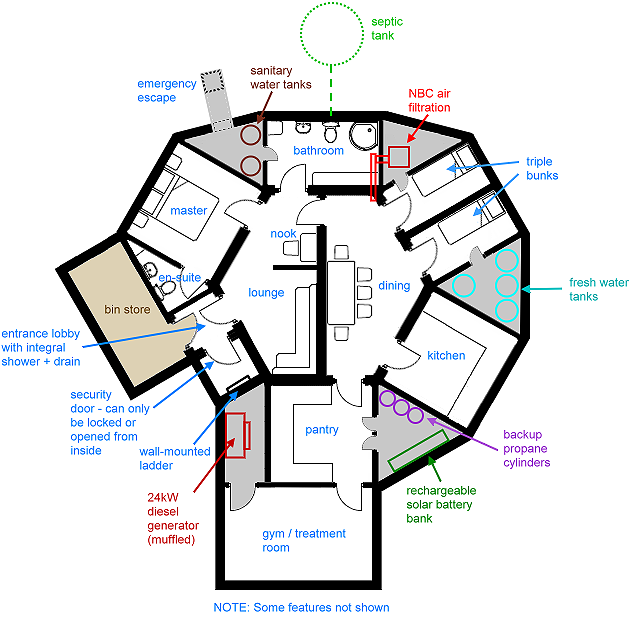
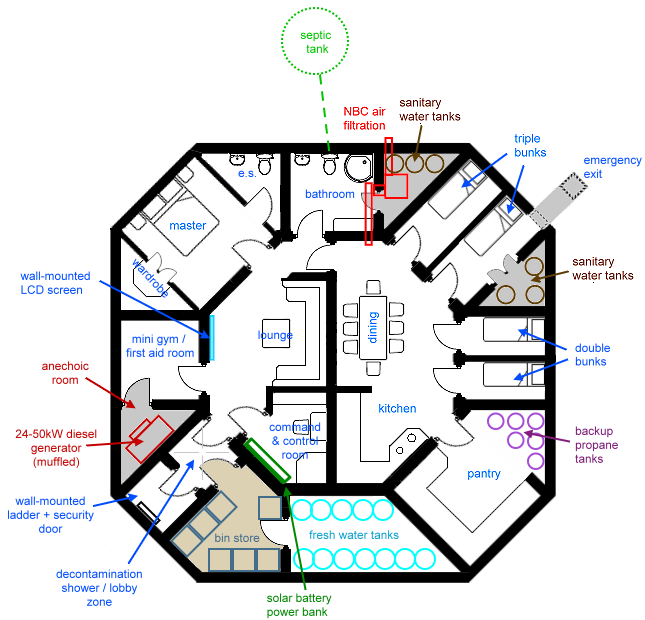
In the examples illustrated, access is through a wall-bolted ladder leading to a thick steel security door that can only be locked from inside the
bunker; the
door has no handles, hinges or keyholes on its external side (facing the ladder), yet opens outwards; this is to make forced entry extremely
difficult.
The entry area would be accessed from a hidden trapdoor-like feature on the floor of a decoy, low-value structure aboveground.
Low voltage lighting should be used as much as reasonably possible, although for prolonged stays care needs to be taken with regard to maintaining
circadian normality – for example, lighting should have minimal blue emissions, at least from late afternoon onwards (more on this further below).
However, a backup LED lighting system should also be in place based on rechargeable batteries (for example) – we can't use candles in the bunker
as they burn up precious oxygen and produce unwanted condensation and carbon monoxide (plus they are a minimal fire hazard).
And because every square inch of space in a bunker is precious, the principle of "verticality" comes into its own in maximising that space, with as
many options for storing things vertically or in a stacked fashion as possible being a key design element.
There should be small fire extinguishers and smoke detectors in every room + carbon monoxide alarms in every sleeping room.
An optional CO2 monitor might be included, but for a properly
NBC
filtered bunker, it is likely to be overkill.
Leafy house plants (e.g. Aloe Vera, Peace Lilies, Boston Ferns, English Ivy) should also feature in most rooms for the purpose of absorbing
moisture from breathing, mould-countering (some species are astonishingly effective at this), air purification and for helping to imbue a sense
of tranquillity.
UV lighting in each of the sleeping quarters would be deployed, ideally activated in the mornings only and for no more than 60 minutes at a time
for air purification (kills mould, kills bacteria, removes odours, revives ozone, kills viruses and kills dust mites).
IR lighting would be installed in the mini gym / treatment room for pain relief (if required) and skin rejuvenation; natural sunlight contains
both UV and IR light and both have health benefits that would be unavailable absent these systems.
Air circulation (with a positive pressure within the bunker) is vital to (a) prevent pooling of stagnant air and odours, (b) purge any viruses
brought in at the time of "bunkering down"
(although the UV should also help with that) and (c) to compensate for oxygen burnt during cooking and heating, but this can be achieved using
very basic, simple expedients (details reserved from these notes).
Water heating should have redundancy but primarily via the generator and backed up using propane (details reserved from these notes).
Bunker time should be used for catching up on healthcare issues and getting plenty of rest, on which point note that in grid-down scenarios
where people are left to shelter in place, it is often the case that sleep greatly improves and lasts several hours longer than usual.
Light boxes to maintain circadian rhythm and to prevent mood problems should, minimally, be kept in the gym / treatment room; due to lack
of natural light throughout the day, it is important for mood regulation and sleep that appropriate light types be experienced at different times
of the day.
Daily routine should be encouraged during the "bunkered down" periods when fallout levels rise or evidence of any fresh wave of strikes emerges
(based on the principle of ongoing missile barrages, arriving in waves every few days or weeks throughout hostilities that might last several months);
ideally one should think of it as being similar to life aboard a submarine, where routine keeps everyone occupied and focussed.
A typical routine for the bunker's "master" might consist of:
- News check (AM/FM/MW radio) on the hour, every hour.
- Ration planning for the day.
- Weather station checks (first thing, noon, dinner time, bed time).
- Radiation monitor checks (as above).
- Exercise in the mini gym.
- Walk-around inspections of the generator room, the bin store, the water store and the pantry, looking for signs of electrical faults, loose water seals, etc.
- Clean-up of rooms, wipe-down of equipment (these chores to be delegated to other occupants).
- Bunker systems checks (e.g. generator output, NBC, etc.)
- Bunker air quality monitor checks.
- Lots of reading!
- Arranging a showing on the lounge's LCD screen for each evening (for example) of a film or documentary, to maintain a semblance of normality.
- Ensuring everyone is fed and well hydrated and well rested.
- Speaking to everyone in the bunker on a one-to-one basis at least once per day to maintain morale and vigilance.
It is an extraordinary situation that such bunkers are designed for, and accordingly there is a requirement for discipline and a temporarily regimented approach to certain aspects of it, but stress reduction is also essential to help maintain morale and focus.
Additional Notes
HEATING: At temperature latitudes, subterranean shelters like this tend to stabilise at around 13 degrees C (+/- 1-2 degrees)
without any heating input; in fact, cooling might be more of a concern during occupation! That said, heating will be needed to some extent for the
colder times of the year, especially during the day time, and ideally using propane catalytic
heaters (very safe, very efficient (cheap to run), use the same fuel as the stove / hob), strictly arranged in a space-by-space basis as some people
have low tolerance of warmth during sleeping hours and others have a higher requirement for it; hot water bottles for each sleeping position should
also be provided.
DEHUMIDIFYING: Aside from the house plants, a dehumidifier should be installed adjacent to the NBC air filter and mounted
on the wall; the run-off water can then be used to top-up the sanitary water supply.
CUSTOMISABLE: The sample designs serve as a baseline or starting point for 8-14 berth survival shelters, but can be modified to
client's requirements, including creating provision for pets and / or disabled access.
EXTERNAL FEATURES: Obfuscation of entrance, vents and sensors. IR sensors + cameras on main dwelling; the entrance should be under
a ramshackle
shed or other low value structure and the access point well obscured; nevertheless, it should be robust enough to allow the bunker occupants to
spend short periods each day (of the order of 5-10 minutes) above ground to experience morale-boosting sight of the world outside in all but the
most severe fallout conditions.
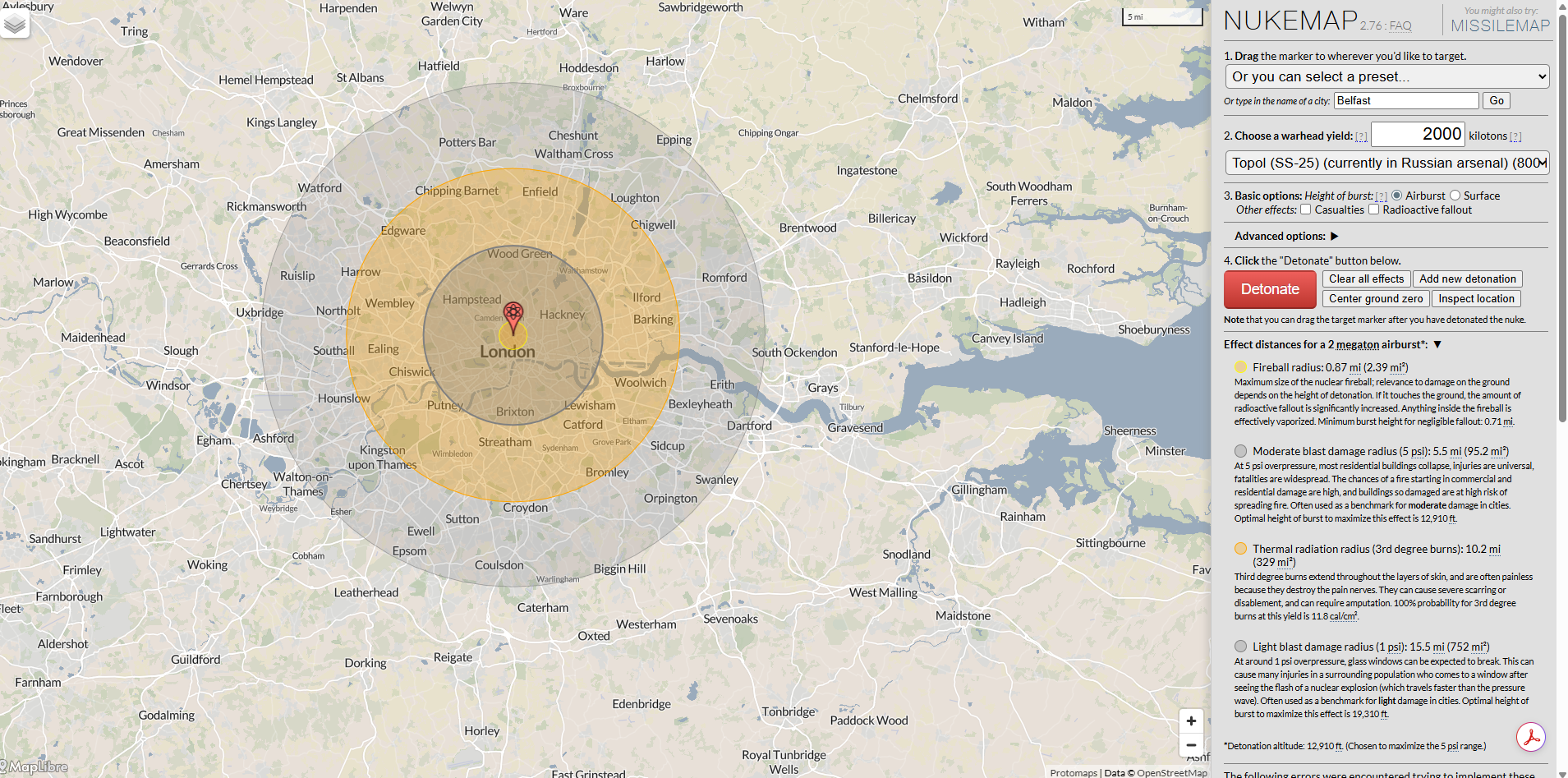
BLAST DOORS? Given that we assess that if blast doors are required, then the bunker is located too close to a projected target
for viable post-strike resumption of day-to-day living in any reasonably bearable sense; in other words, we consider it foolish to build bunkers
within or close to projected blast radii.
PLANNING CONSIDERATIONS: It's up to the client whether or not to seek planning permission for these structures, but from an OPSEC
perspective, if you do you are effectively signposting your bunker as a curiosity and a subsequent rallying point to everyone involved in a formal
planning application; you might as well erect a flashing neon sign above it saying, "FALLOUT SHELTER WITH BOUNTIFUL SUPPLIES HERE!"
Recommended Reading


Recommended Websites
Home of World Affairs Brief: joelskousen.com has some great resources, and although we do not
agree with everything Joel says, we largely concur with his main theses regarding the coming nuclear war with Russia and the great imperative to get ready for it now.
The best blog on Russian & Chinese strategy: J.R. Nyquist's Blog.
News and concise analysis of other issues (beyond WW3 concerns) of interest to conservative readers: Cryptogon.
Alex Wellerstein's Nuclear Secrecy blog and home of the famous
NUKEMAP interactive nuclear explosion mapping tool.