Frequently Asked Questions
Question #1: Can you Describe the Actual Life-Threatening Effects of a Nuclear Explosion?
A nuclear detonation poses two basic categories of direct lethal effects:
- The initial explosion's effects.
- The subsequent fallout's effects.
(To these might be added the aftermath effects of lawlessness, sickness, societal collapse, supply chain collapse, etc.)
The initial explosion's effects are a blindingly hot fireball, then the immediate blast zone (spanning typically 10 miles in diameter), then the scorch
zone
(thermal radiation zone, typically double the diameter of the immediate blast zone and within which third degree burns are a certainty for anyone
exposed to the air), and finally the outer blast zone (typically 30 miles in diameter and causing broken windows, lesser structural damage, etc.) -
you can experiment with these projected effects yourself in
this interactive map.
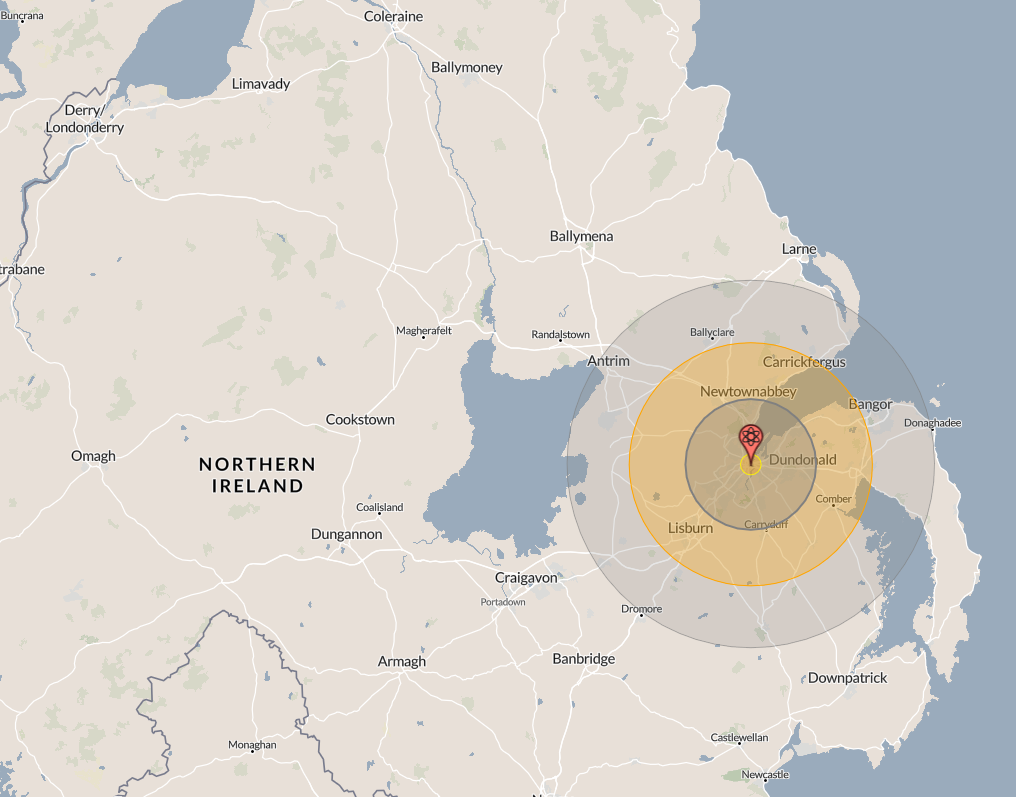
• Inner fireball
• Inner blast zone (catastrophic structural damage)
• Thermal radiation scorch zone
• Outer blast zone (lesser structural damage)
(Map data © OpenStreetMap contributors, CC-BY-SA, Imagery © Mapbox)
The highly irradiated (and therefore lethal) dust churned up by the fireball's impact with the ground (especially with groundbursts as opposed to airburst explosions) is termed nuclear fallout and poses a threat to life downwind of the detonation. We design shelters to survive fallout, not the initial explosion's immediate effects as we maintain that civilian shelters should not be sited within the hyper-destructive blast radii, and ideally not within thermal radiation radii either, as the survivability post-event is likely to be low.
Question #2: What Type of Radiation Comes From a Nuclear Explosion?
In addition to immense thermal radiation (i.e. heat), the initial blast produces a burst lasting around one minute in duration, of dangerous ionising radiation in the form of X-rays and:
- Neutron radiation, the most lethal of all kinds of nuclear radiation, up to 10x worse than the deadly gamma radiation (of which more is said below). Consisting of high energy neutrons that penetrate through solid objects and devastate living tissue, this destroys life at an atomic level (i.e. even lower than at a cellular level) and damages physical materials. However, if you are close enough to experience neutron radiation from a typical modern nuclear weapon (as opposed to a low-yield neutron bomb), then the thermal radiation (i.e. the immense heat) of the fireball will incinerate you before the neutrons can kill you.
- Gamma rays, which are electromagnetic waves that readily penetrate and damage living tissue at an atomic level, disrupting DNA, injuring cell linings, accelerating cell division in the bone marrow and digestive tract, and triggering cancers longer term; gamma rays form the major health threat posed by the radioactive fallout that ensues from a nuclear strike.
Question #3: What Type of Radiation Comes From Nuclear Fallout?
As dust and debris from a nuclear explosion are lifted up into the atmosphere and are transported by the wind, they eventually fall back to earth and settle on the ground, buildings, trees, lakes, rivers, etc., as radioactive fallout, emitting the following types of radiation:
- Gamma radiation, as described above.
- Alpha particles, which are heavy helium nuclei that cannot penetrate human skin but are the most lethal of all forms of ionising radiation if inhaled or ingested during unprotected contact with fallout; this, incidentally, was the type of radiation that was used, via the spiking of a drink with polonium-210, to assassinate Alexander Litvinenko.
- Beta particles, which are high speed electrons or positrons emitted during atomic decay; their effects on human health tend to be superficial burning on the skin and eyes, but pose full lethality if emitted from an ingested source, such as unintentionally inhaled fallout; this also happens to be the type of radiation used in radiotherapy directed at tumours.
Of the three listed above, the focus of fallout sheltering is to protect against gamma radiation as it is the most difficult to achieve effective shielding against.
Question #4: What Type of Weapons are Likely to be Deployed Against us in a Nuclear War?
- Thermonuclear warheads (aka hydrogen bombs, i.e. nuclear fusion weapons) with yields up to 5 megatons (in the case of China's Dong-Feng 5), an order of magnitude much more powerful than the weapons used in Hiroshima and Nagasaki, which were primitive fission bombs of yields of the mid-teens in kilotons, a mere fraction of the newer weapons.
- According to defector literature, Russia not only possesses but intends to use biological weapons during a nuclear conflict with the West, albeit their efficacy is disputed.
- During the ongoing conflict in Ukraine, Russia has reportedly deployed - with limited effects - banned chemical weaponry.
We deem it safe to say that in an actual war all arms treaties and conventions can be expected to be ignored; that being the case, Russia might
in extremis be able to deploy a cobalt bomb, which is
speculated as an extremely perfidious weapon designed to produce a lingering fallout-borne radiation that renders the target region uninhabitable for
decades due to the long half-lives of the isotopes generated thereby. However, to the best of our knowledge there is no verifiable proof that any
nation-state possesses or would dare to use such an environmentally catastrophic weapon, for fear of long-term impacts on its own homeland,
and we perceive there is circumstantial evidence that the threat of such weapons may be a psychological operation to instil fear in western populations,
with a view to them pressurising their politicians to lobby for more accommodating relations with Russia.
Likewise we regard Russian boasts of a tsunami-generating effect from its
Poseidon autonomous underwater
weapon to be a psychological operation designed to manipulate the public in the UK into pushing for peaceful relations with Russia.
| Population | Warhead Yield | Weapon Platform | Destroy Radius (Heat + Blast) | NOTES |
|---|---|---|---|---|
| up to 200K | 100-150 Kt x 1 per salvo | Bulava SS-N-32 | 2.3 - 3.3 miles | Submarine-launched, 6 warheads on each missile |
| 200K - 500K | 750 Kt x 1 per salvo | Sarmat RS-28 "Satan II" | 2.6 - 5.9 miles | Silo-launched ICBM |
| 500K - 1M | 1 Mt x 1 per salvo | Topol SS-27 "Sickle-M" | 4.3 - 7.6 miles | Silo- and mobile-launched ICBM with multiple warheads |
| 1M - 2.5M | 1 Mt x 2 per salvo | Topol SS-27 "Sickle-M" | 4.3 - 7.6 miles | Multiple strikes per salvo |
| LONDON (8M+) | 1 Mt x 10 per salvo | Topol SS-27 "Sickle-M" | 4.3 - 7.6 miles | Saturation strikes per salvo |
For an estimate of Russia's current arsenal, see Russian nuclear weapons, 2026; and for a comparison of modern nuclear warhead effects, see the video below:
Question #5: What are the Likely Target Criteria in a Nuclear War?
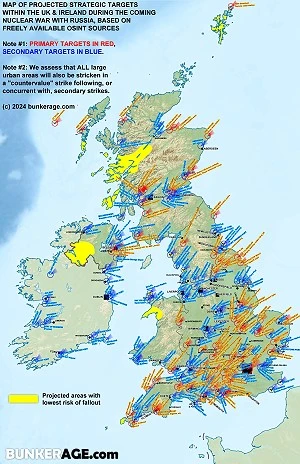
Primary targets in a by-the-book, Counterforce initialisation
of hostilities would be command-and-control infrastructure, military bases, government installations,
telecoms, the nuclear deterrent itself (bases and submarines if location known), and seaborne aircraft carrier groups, with secondary targets being
ports, airports, industry (especially the arms industry) refineries, power stations, etc.
However, in a more wanton and less restrained
Countervalue scenario, such as that outlined below under
How Will we Know When Nuclear War is About to Start?,
every major city and large town, plus possibly some medium-sized towns, would become targets for a Russian arsenal that has more than
enough warheads to devastate the population bases of all of the West, perhaps multiple times over.
Question #6: Can you Quantify the Fallout Risk Posed by a Strike on a City?
It depends on the size of the warhead's yield and whether or not it is an airburst or a groundburst; higher yields produce more fallout than smaller
yields do, so being downwind of large cities or target-rich areas (e.g. the Ruhr valley or north-west England) greatly increases potential exposure
to fallout.
In any case, we work on the following assumptions:
- Russia will be the attacking nation, it possessing the world's largest nuclear arsenal and ever since its invasion of Ukraine has been routinely threatening to strike at the West with nuclear weapons. (China, its ally, we assess to be more concerned with striking at Japan, the Philippines, Australia, New Zealand, and the western United States.)
- Even though Russia allegedly models its strike regimes on decapitation of western governments and the destruction of military infrastructure, we predict it will also, or perhaps even predominantly, attack the cities (major and minor) in multiple barrages per city.
- Projected late-era Cold War yields for city strikes were of the order of 1-2 megatons and 1 Mt is also the reported yield on the current Russian RS-28 Sarmat (Satan II) ICBM, and so we assume that nuclear strikes on the larger urban areas of the UK and Ireland would entail yields of that order.
- The UK's Cold War war-gaming exercises (notably "Scrum Half") envisaged the deployment of first an airburst and then a groundburst on certain cities (including Dublin in "neutral" Ireland); the airburst is to "stomp" on the city and would demolish most of its buildings (this was the technique used against Japan in WW2) and the groundburst would then impact any hardened subterranean infrastructure, notably military and command-and-control sites.
- We further assume that Russia maintains the doctrine of multiple salvoes directed at the same target in an "overkill" strategy, possibly ranging across multiple weeks or even longer.
- If only one detonation were to strike each city, we assess Russia would enact airbursts between 12,000 and 20,000 feet above the city centres, which makes for a lesser degree of ensuing fallout; however, given Russia's reported policy of saturation / overkill, we have to plan for a likely worst case scenario in which groundbursts are also certain, greatly increasing the fallout payload.
- Rainfall or snowfall meeting a cloud of fallout will draw it earthward much sooner than if it were to drift through clear air, the implication being that fallout is expected to be more localised (to targets) in wet climates such as the UK's than in dry climates, especially in winter, the very season in which Russia has traditionally been expected to strike. That in turn implies that fallout presents a higher post-strike hazard in the UK than say, in Spain, because the sooner it falls to the ground after a nuclear detonation, the more potent its radiation is.
- Port cities will, we assess, be more likely to receive either a groundburst alone, or more likely a groundburst plus an airburst, whereas most inland targets (bar London) are more likely to be subjected to airbursts alone; the reasoning is that ports are high-value targets and must be rendered utterly unusable by NATO forces.
The actual projected track of fallout (assuming ongoing stable weather conditions) from a nuclear detonation is described well by Joel Skousen in The High Security Shelter:
"...the downwind deadly zone (where dosage exceeds 1000 rems) for a 2 megaton weapon (i.e. a yield expected to destroy a city), with 15 mph winds is an area 40 miles downwind and 10 miles wide within 18 hours of the explosion. After a week, the deadly zone is 80 miles long and 20 miles wide. On the positive side, most people outside of this range will only receive radiation in the 100–300 rems per day range, depending upon the distance, which gives somewhat more leeway. But long-term illness such as cancer and leukemia are still a major threat."
Question #7: What are the Specific Health Risks of Exposure to the Radiation From Fallout?
Downwind of any nuclear detonation, radiation up to 3,000 rems
("Roentgen equivalent man") per hour is
possible from the fallout, with 1,000 rems being the threshold of very rapid fatality for most people.
Because the two key metrics in assessing radiation dangers are (1) intensity and (2) duration of exposure, the health risks from fallout are
best mitigated both through minimising the time one is exposed to it and through expedients that block the radiation from reaching human tissue.
Furthermore, the most vulnerable groups with respect to ionising cancers are assessed as very young children, the middle-aged, and generally women more
than men.
| Exposure | Duration | Immediate Effect | Long-Term Effect |
|---|---|---|---|
| 100 rems | < a few hours | Mild radiation sickness | Slightly increased cancer risk |
| 100-200 rems | < 30 days | Major radiation sickness | Notably increased cancer risk |
| 200-500 rems | > 10 days | Serious radiation sickness / death | Notably increased cancer risk |
| 500+ rems | n/a | Severe illness, death within weeks
(but recovery sometimes possible) |
n/a |
| 1000+ rems | n/a | Acute illness, certain death within weeks | n/a |
Question #8: What is the Risk Posed by an EMP Strike?
It is assumed that any major nuclear strike against the West will commence with a cluster of nuclear detonations above the atmosphere in space
with a view to generating powerful electromagnetic pulses (EMPs) to destroy electronics and electrical devices (including car engine starters)
on the ground and thereby immobilising the target territory's transport and communications systems, including its space-based military infrastructure.
The continental United States is seen as particularly vulnerable to such an attack, with half a dozen EMP explosions taken as enough to disable its
entire electrical grid, with estimates of the order of 12 months or more required to restore the damaged components, all else being equal so to speak,
but in a WW3 context that could take much longer due to expected problems in sourcing vital parts, many of which are currently (or so the story goes)
manufactured exclusively in China.
Anecdotally (i.e. we have not seen this formally verified), the UK is less vulnerable due to the design of its electrical grid, but nevertheless many electronic
devices would be "fried" unless
shielded from EMP pulses through some kind of
Faraday Cage expedient; smaller items could be effectively protected
by storing them in a closed metal box (e.g. a tool box) or perhaps a microwave oven.
However, unprotected motor vehicles and solar panels (for example) would be very exposed.
(Note that EMP-proof solar panels are now available on the market specifically for this reason.)
Regardless of how durable the national grid might be in reality, we take the view that private preparations for the war should assume the worst and accordingly
expect water-pumping stations to be disabled (for both fresh water supply and foul water removal), and expect mains electricity to be gone,
with internet and phone services also destroyed.
Question #9: Would a Nuclear Strike Trigger Firestorms?
We assess the risk of devastating firestorms erupting from a nuclear strike to be low in the UK due to (a) the construction methods used in modern cities, (b) the damp climate and (c) the relative lack of forest cover in this country.
Question #10: Won't a Nuclear War Cause a "Nuclear Winter"?
No, because we agree with others who have judged the
projections of the late Carl Sagan
et al to have been fundamentally flawed (i.e. biased) in favour of an outcome that gave Russian propagandists in the Cold War era massive leverage in
lobbying for the US to dramatically reduce its number of warheads; see our article,
Annie Jacobsen's Nonsense & the 5 Worst Nuclear War Myths.
Cresson Kearny writes in his seminal guide,
Nuclear War Survival Skills:
"...Non-propagandizing scientists recently have calculated that the climatic and other environmental effects of even an all-out nuclear war would be much less severe than the catastrophic effects repeatedly publicized by popular astronomer Carl Sagan and his fellow activist scientists, and by all the involved Soviet scientists. Conclusions reached from these recent, realistic calculations are summarized in an article, 'Nuclear Winter Reappraised', featured in the 1986 summer issue of Foreign Affairs, the prestigious quarterly of the Council on Foreign Relations."
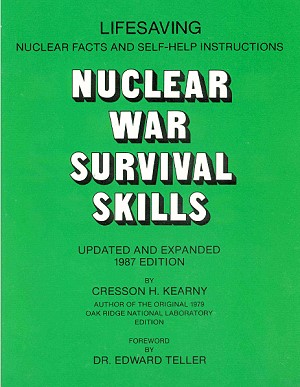
(You can download an older edition of that book in PDF format for free on our Downloads page)
Question #11: How Likely is a Nuclear War and When Might we Expect it to Happen?
We judge nuclear war to be both inevitable and likely to take place around the end of the present decade, based on numerous metrics, including but not limited to:
- Russia and China are following the predicted path to nuclear war described in defector testimony.
- Russia is implementing extensive psychological preparations of its people for near-term nuclear war with the West (preparations which some of us have witnessed firsthand).
- We have anecdotal evidence that Russia is preparing new civil defence measures for its people, including nuclear emergency training drills.
- Russia and China have been frantically modernising and expanding their armed forces ("Russia is nearing the completion of a decades-long effort to replace most of its strategic and non-strategic nuclear-capable systems with newer versions.")
- Russia’s economy (and some say China's also) has transitioned from peacetime mode into a war economy, with its military consuming ca. 40% of its government spending in 2025 (see this article).
- Russia's seemingly senseless invasion of Ukraine is an urgent pre-war strategic move designed to secure its western flank in advance of global war (among other reasons).
- China is expected to attack Taiwan by 2027 according to the Davidson Window projections (albeit disputed by others); we assess this to be perhaps premature.
- Narrative-building and public consent for massive surges in defence spending in Europe are being synthesised by US President Donald Trump's hollow threats (for consumption by the masses only) to forsake NATO (the US is now preparing to grant nuclear sharing to several eastern European NATO countries (see this article)); meanwhile, for the UK's own war preparations, see our article Critical Assessment of the National Security Strategy 2025 (NSS 2025).
- Extensive defensive lines are bing constructed in Poland, the Baltics and Finland.
- Urgent plans for bunker-building are in place in Germany, Poland and other continental countries.
- Well-informed billionaire elites are hastily constructing bunkers that are blatantly obviously designed for nuclear war survival.
Question #12: How Will we Know When Nuclear War is About to Start?
In the now-declassified Cold War era "War Books" of the UK government, the concept of "transition to war" was mooted, in which numerous "tells"
would appear, such as mobilisations, major troop movements, certain submarine deployments, embassy closures, relocation of national treasures,
cancellation of public events, sudden shortages of foods and medicines, sudden travel restrictions, high profile assassinations in the West,
surges in terror attacks, and probing incursions into minor NATO countries (e.g. Denmark) to test or break NATO's commitment to
Article 5.
However, while some of the foregoing is dated and superseded by modern intelligence-gathering methods, the signs of imminence are nonetheless
predicated on certain "expected" developments, such as a major cyberattack, a sudden breakout of China in the Pacific (to seize Taiwan), a North
Korean invasion of South Korea (requiring a speculated immediate US tactical nuclear strike to stop it in its tracks), etc.
Be that as it may, we assess the greatest red flag of all to be any kind of decapitation or termination of the present Russian high command
(i.e. the violent death of Putin and his senior generals); should that occur, either the Russian
"dead hand" system or what remains of the
succession of command can be expected to vindictively initiate a massive all-out first strike against the West, in which case we would have no more
than a few hours to locate to shelter (longstanding cultural Russian thought on this runs along the lines of "if we can't win, we'll bring
the world down with us" and any calamitous destruction of its high command is very likely to elicit that response, especially further given that
Russia has extensive civil defence sheltering for much of its population and may gamble on emerging as a functioning nation from a mutually destructive
nuclear exchange with a relatively unprotected West.)
One of the Cold War policies of the UK government was to deter the public from making last-minute panicked evacuation efforts, as the road network was to
be kept as free as possible for military and government traffic, and so fatalism towards the survivability of a nuclear war was seen as helpful to
ensuring the continuance of the state itself; we take the view that all UK governments since that Cold War have retained that policy.
That being the case, plausible cover for locking the country down on the eve of war might be a re-enactment of the restrictions imposed during the
Covid-19 pandemic, i.e., a viral outbreak might be asserted or even effected.
Question #13: Why Does the Government Not Provide the Kind of Civic Sheltering Seen in Other Countries?
When the UK was pondering the development of its own nuclear weapons, some form of feasibility study was made that concluded that the country
could not afford both civil defence measures and a nuclear deterrent, so the decision was made to pursue the latter alone; around the same time, other
countries took the opposite view and focussed on building bunkers (notably Finland, Sweden and Switzerland, albeit the Swiss for a time wanted to do
both, rather like Israel has done).
Successive British governments have adopted the same longstanding policy as that established back in the 1950s, with only token attention given to civil
defence and with much more energy invested in lying to the people that bunkering would be pointless as it would be ineffective and everyone would die
anyway; but this stands in stark contrast to the policy of the above-named nations who consider nuclear war to be survivable, with even densely populated
Germany taking steps
in recent times to prepare for an urgent bunker-refurbishment programme (with some reports revealing they intend to convert underground car parks and
subways into makeshift shelters as well).
Question #14: How Strong Should Protection Against Radiation be in a Shelter?
By most accounts, the "gold standard" (where money is no object) is to reduce gamma radiation from settling fallout by a factor of 1,000 although
notably
J Skousen considers a mere factor of 32 enough for most situations, bar being close to and immediately downwind of a projected target.
Protection doubles with every 2 inches' thickness of concrete and so Skousen's baseline factor of 32, which requires one foot of concrete
atop the shelter, can be doubled to 64 with just another 2 inches of concrete, as follows:
| RF | Reinforced Concrete alone | Soil alone (assuming appropriate structural support!) | Concrete + Soil on Top | COMMENT |
|---|---|---|---|---|
| 32 | 12" | 36" | 8" cncrt. + 12" soil | Suitable for most rural areas, esp. low risk zones well away from targets |
| 64 | 14" | 42" | 10" cncrt. + 12" soil | |
| 128 | 16" | 48" | 12" cncrt. + 12" soil | |
| 256 | 18" | 54" | 12" cncrt. + 18" soil | |
| 512 | 20" | 60" | 15" cncrt. + 15" soil | |
| 1024 | 22" | 66" | 17" cncrt. + 15" soil | The Swiss bunker standard, for densely populated areas expected to lie close to, and in the wake of, one or more major targets; this is considered prohibitively expensive and very much overkill by some experts, notably J Skousen, except where the shelter is sited very close to one or more projected target(s) in which case blast doors are also required; but it is our strong opinion (and Skousen's) that it would be much wiser to invest one's shelter budget in a rural location well removed from major targets and ideally upwind of them. |
Question #15: Is Air-Filtration Really Necessary in a Fallout Shelter?
Going by risk assessments undertaken by others, ventilation is even more important than air filtration as the risk of progressive
suffocation from stale air (i.e. too much exhaled carbon dioxide) is higher than the risk of inhalation of rogue fallout particles entering the
shelter; nevertheless, that does not alter the fact that a shelter should still incorporate full NBC filtration with anti-condensation measures
(this being especially important in warm summer weather, as warm air entering the shelter becomes a subsequent condensation hazard on cool walls).
If Russia were to follow the pattern outlined by the defectors, then we might reasonably expect a significant biological warfare threat right before
or shortly after a nuclear strike, in which case full NBC filtering becomes even more vital.
Question #16: What Kind of NBC Air Filtration do You Recommend?
We like the popular Swiss models from Lunor or Andair, although by no means do we insist on using those brands. There are lower cost options (right down to making your own filters if you have the know-how and the confidence to do so).
Question #17: Is a Nuclear War Really Survivable?
Obviously the bunker-building elites think so and certainly the governments of Sweden, Norway, Finland, Switzerland, Poland and Germany think so too,
going by their renewed bunker-building spree and open urgings to their populations to make preparations.
Likewise the British and American governments regard nuclear war as survivable, to which end they have been making preparations of their own for
decades, while encouraging their citizens to indulge in resigned fatalism so that we do nothing, presumably to avoid being lobbied to disarm and
to spend money on expensive sheltering.
And, of course, Russia and China also believe such a war is both survivable and winnable, and have had their own civic and governmental
sheltering projects for years.
Question #18: Can Shelters be Designed for Dual-Use?
Yes, and in fact we encourage dual-use so that familiarity, regular ventilation and inspection can take place. This would all form part of your
psychological preparations in advance of using the shelter.
Dual-use might entail having part of the shelter serve as a gym, a private office, a games room, and so on.
Care would nevertheless need to be taken to protect its specialised features from damage by children and pets, and in general the shelter's
ultimate purpose might best not be disclosed to very young children, extended family or friends, for OPSEC purposes.
Question #19: What are the Health Side Effects of Confinement Within a Fallout Shelter?
Lack of exposure to sunlight will soon degrade the body's stores of vitamin D3 and will disrupt the circadian rhythm, leading to morale issues
(e.g. "cabin fever", elevated stress, disrupted sleep patterns, depression, irritability, etc.)
To counter these issues, the shelter's occupants should have a daily routine that consists of rising at the same time each morning, exposure
to illumination from
light therapy boxes
upon wake-up, vitamin D3 + K2 consumption with breakfast along with B-vitamins and magnesium glycinate, plus perhaps zinc (which gets depleted during
stress), all of which would be what we view as the minimal "bunker stack" of supplements.
During the day, full spectrum lighting that emulates natural sunlight should be used, or better still, a sunpipe (with properly shielded bends to prevent
gamma penetration).
Conversely, blue light emission in the evenings is a health problem as it suppresses melatonin production; instead,
specialised evening lighting
should be used for the later part of the day.
Daily routine is also essential for morale, so everyone in the shelter should have designated chores to do, as well as adequate rest and leisure time,
with a focal point of the day being a shared mealtime for family interaction (the fundamental element of a social life), followed perhaps by a
DVD film viewing in the evening.
It may be helpful to think of it as being somewhat like a submarine crew's lifestyle for a while, only on a mini-scale.
Question #20: How do you Prevent Condensation Within the Shelter?
Late winter, spring and early summer are particularly high risk times for condensation to form on cool surfaces with substantial thermal mass, i.e.,
uninsulated shelter walls, leading to mould, unwanted dripping and potential short-circuiting of electrical appliances.
Key elements of countering condensation:
- External waterproofing of concrete walls, with bituminous tanking (for example).
- The use of Insulating Concrete Forms (ICF) in construction (does not apply to our culverted shelters, obviously).
- Humidifying appliances, e.g., vented clothes dryers should perhaps not be considered for the shelter; even condensing equivalents can leak and, aside from their humidity problems are an expensive drain on precious electricity; better to have multiple changes of clothing and to maintain personal hygiene for most of the week with wet cloths that can be wrung out, reserving any shower unit use for once a week per person to manage the relevant resources.
- Clothes horses for drying produce moisture that has to go somewhere and that invariably would end up condensing on the walls, so again, try to avoid the need through having changes of clothing.
- Extensive use of house plants, notably Aloe vera (which requires very little watering), Japanese peace lilies and English ivy oxygenate the air, elevate mood (allegedly) and draw moisture from the air and thereby tend to prevent mould forming.
- A dehumidifier should be used for countering condensation from humidity, but if used for long unbroken periods (many months or even years) can paradoxically eventually lead to moisture being drawn from any breach in the concrete's external waterproofing, thereby degrading the concrete; perhaps best to deploy them during the actual emergency or a few times per year in the meantime as a "maintenance" cycle.
- Cooking within the bunker should be planned so as to avoid long simmering stews or soups.
- Insulating the interior of the shelter's walls with a vapour- / water-proof rigid foam board 1 to 2 inches thick.
Question #21: What is Your View on Fitting Specialised Blast Doors?
Most of the Swiss bunkers designed during the Cold War were fitted with monolithic blast doors, designed for:
- Much higher yields - in those days, Russia deployed warheads up to 20 Mt, whereas today they use much lower yields of the order of 1 Mt (and considerably less)
- A target-rich environment, with Switzerland being a very densely populated country (along its northern plains aka "plateau").
Meanwhile, our position is that if your shelter requires a blast door, then you are locating it dangerously close to a projected target and therefore
your entire survival strategy is very flawed. Better by far to locate the shelter well away from major cities and military targets, and ideally
upwind from them with respect to the prevailing track of airmasses, which in the UK for most of the year is from the south-west.
However, it has long been speculated
that Russian strikes might occur in mid-to-late winter (so that recovery actions are hindered by short daylight hours and colder weather), and during this
period northerly and easterly movements of airmasses are not unknown.
Question #22: Will the Survivors Act in a Predatory Fashion or Will Stoicism and Societal Cohesion Prevail?
Some experts take the view that western society is generally amiable and well disposed to civic cooperation in a crisis, and would cite in support of
that position the conduct of our forbearers during World War 2's Blitz and the austere measures that were widely accepted by the people then.
However, we take the view that people today have been thoroughly demoralised by social changes foisted on them against their will, and that many if not
most people are extremely stressed and worn out by multiple issues.
Furthermore, we believe that in a nuclear war scenario, the entrenched fatalism that has been subtly drummed into us by successive governments will
lead many survivors to despair and others to conclude that we are in an every-man-for-himself free-for-all situation, and accordingly we hold that
a survival shelter should also incorporate some provision for surviving a very lawless aftermath of a nuclear war, as well as the actual war
itself, at least until such times as order can be restored.
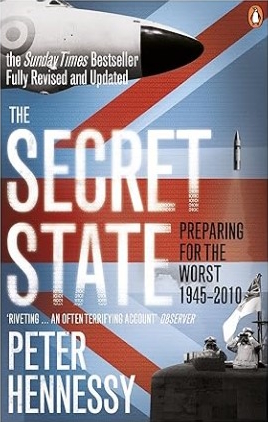
For some cameos of how the British governments in the 1970s and 1980s saw conditions for the survivors, we would refer the reader to
The Secret State by Peter
Hennessy, in which declassified UK government "War Books" reveal some chilling plans for the survivors and the assumption that a stiff upper lip attitude
would be replaced by a ruthless "Mad Max" outlook among many:
- The UK would be broken up into emergency regions, headed up by regional governors acting under Royal prerogative (i.e. answerable directly to the king, not to Parliament), and exercising martial powers.
- Middle-aged and older survivors would generally be seen as "expendable" and could, if an objective required it, be ordered at gunpoint to make forays into irradiated areas.
- Martial law would be in place, complete with summary executions for non-compliance with strict orders from police or army.
- Rationing of supplies would be enforced, with younger people (of parental age or capability) and children given priority.
- Very probably, private property and personal supplies could be seized without compensation.
Question #23: What is Your Opinion of the Steel Fabricated Bunkers Such as Those Made by Atlas?
Atlas Shelters are fine for many parts of the world but we consider
them (a) to pose an OPSEC risk (during transportation and installation) in a densely populated country, and (b) to be unsuited to installation in areas
with the kind of high water tables that are common in many parts of the UK.
That said, we believe (anecdotally) that some have been installed in the UK.
Question #24: Do Your Designs Incorporate Solutions for Rubbish Disposal?
Yes, but these are designed on a project-by-project basis; you can see some examples of how we address this issue in our "Hexabunker" and "Octabunker" long-stay survival shelter designs.
Question #25: What About Toilet Waste Disposal?
This is tailored for on a case-by-case basis, and can range from ultra low cost chemical toilets, marine toilets, right up to an expensive-to-implement system of conventional toilets connected to a septic tank.
Question #26: How Should a Shelter be Heated / Cooled?
At temperature latitudes, subterranean shelters tend to stabilise at around 11-13 degrees C (+/- 1-2 degrees) without any heating input when unoccupied,
regardless of the time of year, and when in use, cooling rather than heating can be the bigger issue.
That said, heating may be needed to some extent in winter (the projected time of the year Russia would strike in),
and one option would be propane catalytic heaters
(very safe, very efficient (cheap to run), use the same fuel as the stove / hob), strictly arranged in a space-by-space basis as some people have
very low tolerance of warmth during sleeping hours whereas others have a higher requirement for it.
Hot water bottles for each sleeping position should also be provided.
If you require air conditioning or heat pumps, only a 24-50kW diesel generator will realistically suffice (see
our "Octabunker" design).
(Note that all shelters should have carbon monoxide and smoke alarms installed.)
Question #27: How do we Maintain OPSEC When Dealing With Planners?
Options can be discussed during consultation, but for now consider that your shelter is a matter of life and death; plan your stance on the planning issue accordingly.
Question #28: How do we Maintain OPSEC if Tradesmen Know What I am Doing?
The sensitive nature of our work demands complete protection of client's identity and what is actually being built.
Accordingly, we do not use a contractor but instead manage projects in-house, overseeing the flow of components from a range of approved manufacturers
plus the flow of separate trades at different times, none of whom will be made aware of the true purpose of their work.
Question #29: How do You Propose the Shelter's Entrance Should be Secured?
The thick steel entrance doors are tactically concealed and in the unlikely event of being discovered, entrances are
designed so as to make them extremely difficult to breach.
This door additionally has a seal around its perimeter to prevent air penetration from outside, forming part of a doubly sealed airtight entrance block.
Question #30: How Would I Know What is Happening Outside my Shelter?
All shelter designs should feature at least one external camera, a radiation meter, a weather station (for tracking air masses), motion sensors, etc., all relayed back to a control station, along with AM/FM radio.
Question #31: How Would the Shelter be Powered?
There should be redundancy of systems, with most of the internal lighting and appliances powered from a Tesla Power Wall battery bank (or similar)
connected to EMP-proof solar panels, ideally mounted away from the shelter, typically on a garage roof.
An inverter will be required to convert DC from the battery bank into AC.
For heavier electrical loads, a shelter would realistically require a 24-50kW diesel generator plus enough stored fuel.
Question #32: How Long Would we Have to Stay Inside the Bunker?
It depends on proximity to targets, the number of strikes, and whether or not subsequent salvoes would be fired, AND, it also
depends on the security situation in the aftermath (i.e. lawless marauding, martial law or stoic civic mutual assistance.)
We tend to err on the "worst case" side of the equation when assessing this and believe one should be prepared to stay for prolonhged periods
spanning weeks or even months.
Question #33: How Much Water Would the Shelter Require?
Both drinking water and other-use water must be considered:
- One should plan to allocate 2 litres of drinking water per person per day spent in-shelter, and for this we like these stackable 160 gallon blue water tanks, but there are other options that can be availed of on a project-by-project basis, including fully plumbed in-line water tanks with a cut-off valve within or close to the shelter.
- An additional 5 litres for washing per person per day should be reserved, but it should also be drinkable in the event of an unexpectedly long stay in the shelter.
- Hot water from solar radiators (mounted on the roof of your house, for example) should if practical to do so also be fed to the bunker.
- Shelters should also have a means of manually collecting rainwater, stream water, spring water, etc., when fallout has depleted to a safe level, along with good quality water filtration.
- A grey water recycling strategy should also be devised on a bespoke, per-shelter basis.
Question #34: What Insurances do You Have?
The few of us involved in the project all carry professional indemnity insurance pertaining to our individual professions, while every tradesman engaged would have to have their own also.